I apologize for the dearth of information I've been providing, next post I'll try to explain my absence...
Suffice it to say, I am safe in Abuja, it's quite nice here with clear weather in the 90's on a daily basis. Yummy food, great hosts and I'm actually starting to make some progress on my research.
Of course nobody wants to get too close to me, as I've been in the same basic outfit since Thursday -- my luggage is yet to meet up with me, but I'm real hopeful that today is the day!
Internet access is, as expected, somewhat limited and rather expensive when available (one of the reasons for not posting more). The other being all of my power has been hanging out in my luggage in London...
Abuja is a city of about 2.5-3 million people last I heard. Rather spread out, but not nearly as much as Atlanta. I'll post more about the area later.
Until then...
Kipp
Tuesday, December 13, 2005
Thursday, December 08, 2005
I'm off
Okay, all packed heading to the airport. Quick visit through DC. All day in London tomorrow, then onward to Abuja.
I'll post as bandwidth is accessible.
Kipp
I'll post as bandwidth is accessible.
Kipp

Wednesday, December 07, 2005
The day before

Well, tomorrow is the day I head out for Abuja. Finished up my classes with my final presentation this morning. Now, just clearing my plate for being gone two weeks, making sure I have everything done so I don't come back to a mess!
Walking on campus this morning, was a beautiful fall (some would say winter) day and just had to snap a shot.
Checked the weather for my trip. While London looks to be pretty cool (mid 40's on Friday), Abuja will be mid to upper 90's with lows in the 70's. Sounds like it should be a nice warm trip once I get there.
Received my follow up shot of the Twinrix (Hep A+B) today. That should fill me up on my shots for now, at least I hope so.
My first meeting is scheduled for Monday, December 12th. Arvind and I are planning on meeting with Mrs. Lolia Emakpore, the Executive Officer for the WATRA Secretariat. WATRA is the West Africa Telecommunications Regulators Assembly, which is composed of some 11 West Africa regional telecommunications regulators. We'll likely be working closely with Mrs. Emakpore during our stay in Abuja.
The journey starts tomorrow!
Kipp
Saturday, December 03, 2005
Nebraska trip
 So, I recently got back from a trip back to the plains over Thanksgiving. Yup, I'm from a little itty-bitty town in southwest Nebraska -- Lebanon be the name, and some 70 people now call it home (it was over 100 when I lived there and I think they are exaggerating at 70!).
Took the family and had a chance to visit with more family and friends. It was good to get back, but truy a journey (perhaps in preparation for my next one?).
I also wanted to test my camera in conjunction with the blog, so
 here is a view from a few yards east of my house (facing southwest). The closest neighbor is in the other direction, about 1/4 mile away. The town of Lebanon is about 2.5 miles east, and the nearest 'big' town is 24 miles away, McCook with a population of something around 10,000.
And to get a sense of what my high school was like. A few years back, it was closed and sold to somebody who apparently is trying real hard to become the quintessential redneck. Only he's failing miserably, in my opinion. What good, red-blooded, redneck wouldn't be keeping the football field in good condition and what a waste of a scoreboard! Although you have to admit, they are doing a fine job with the junk in the front, the weeds, and the number of cars parked in front!
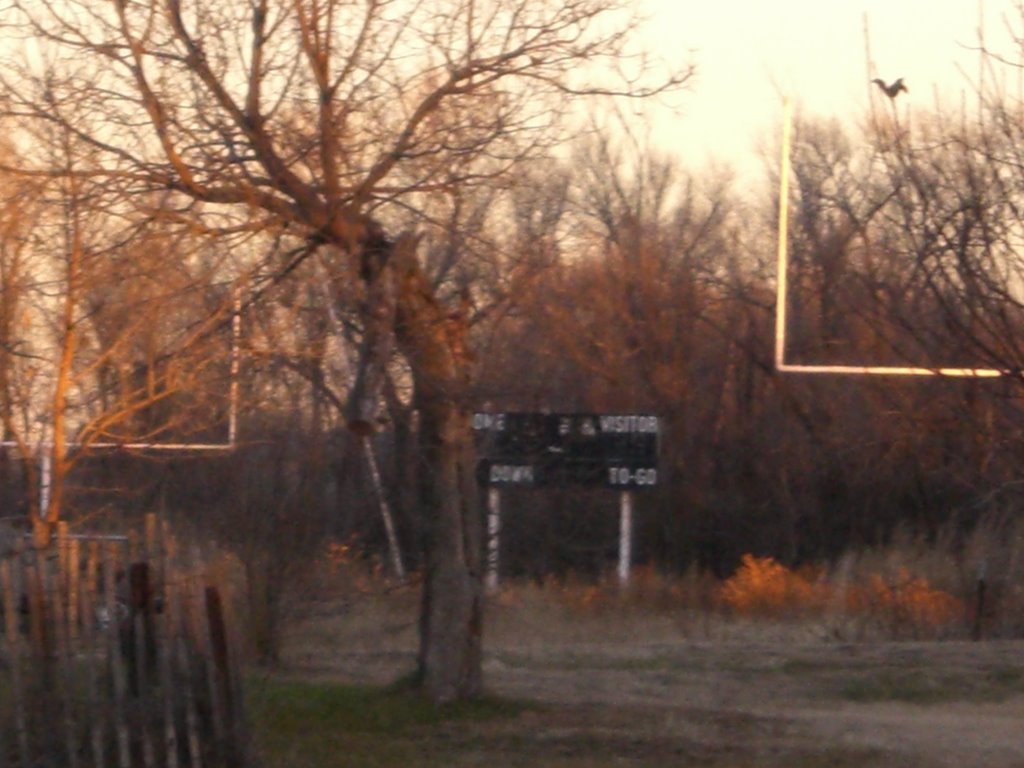
Ah, home...
Preparation for the trip
Okay, so it's getting down to the wire for the trip to Nigeria. I've had my shots (well, except I need another dose of my HepA+B). I've got my Yellow Fever card, I've got my Meningitus shot, my MMR shot, my Tetanus shot, I took my Mefloquine (no hallucinations yet!).
My shopping list for the trip:
- shots (I really dislike those intramuscular injections!)
- diarrehea drugs (really looking forward to getting to use these!)
- flashlight (while I'm staying at the Sheraton, I just want to be sure)
- power converter (Nigeria runs at 220 volts/ 50 Hz, so you need a converter)
- phone jack converter (reportedly Nigeria uses the UK phone jack, but I'll be taking my chances)
- deet or Picaridin mosquito repellent (apparently the Cutter Advanced with picaridin is much nicer to use than deet, with no smell and a light, clean feel on the skin -- http://www.cutterinsectrepellent.com/ProductCategories/PersonalRepellents/Advanced/ )
- food (I grabbed some things from REI so I could save a little cash and have some food when I didn't want to go out)
- knife/leatherman tool - hey, you just never know what you'll need
- water filteration and treatment - I picked up a water bottle from REI with built in microfilteration system as well as a 2 stage iodine water treatment kit just in case
- batteries (my camera and flashlight both run off the same AA batteries)
- little gifts for folk I bother while I'm there
- Visa
- Passport
- Travel docs (copy of flight, visa, passport, etc.)
- cash (some, but I'm not telling you how much!)
- clothes (not sure yet, since I haven't packed, but it'll apparently be pretty hot (90's) during the day and I don't expect to be out too much during the night)
- computer (if you want to know, it's an Apple PowerBook G4)
- camera (casio EX-Z120)
- phone (turns out my little Noika is triband, so I should have GSM coverage using my phone and a new SIM card when I get there. http://www.gsmworld.com/roaming/gsminfo/index.shtml)
- power supplies
That should just about do it, or at least I sure hope so!
My shopping list for the trip:
- shots (I really dislike those intramuscular injections!)
- diarrehea drugs (really looking forward to getting to use these!)
- flashlight (while I'm staying at the Sheraton, I just want to be sure)
- power converter (Nigeria runs at 220 volts/ 50 Hz, so you need a converter)
- phone jack converter (reportedly Nigeria uses the UK phone jack, but I'll be taking my chances)
- deet or Picaridin mosquito repellent (apparently the Cutter Advanced with picaridin is much nicer to use than deet, with no smell and a light, clean feel on the skin -- http://www.cutterinsectrepellent.com/ProductCategories/PersonalRepellents/Advanced/ )
- food (I grabbed some things from REI so I could save a little cash and have some food when I didn't want to go out)
- knife/leatherman tool - hey, you just never know what you'll need
- water filteration and treatment - I picked up a water bottle from REI with built in microfilteration system as well as a 2 stage iodine water treatment kit just in case
- batteries (my camera and flashlight both run off the same AA batteries)
- little gifts for folk I bother while I'm there
- Visa
- Passport
- Travel docs (copy of flight, visa, passport, etc.)
- cash (some, but I'm not telling you how much!)
- clothes (not sure yet, since I haven't packed, but it'll apparently be pretty hot (90's) during the day and I don't expect to be out too much during the night)
- computer (if you want to know, it's an Apple PowerBook G4)
- camera (casio EX-Z120)
- phone (turns out my little Noika is triband, so I should have GSM coverage using my phone and a new SIM card when I get there. http://www.gsmworld.com/roaming/gsminfo/index.shtml)
- power supplies
That should just about do it, or at least I sure hope so!
Tuesday, November 22, 2005
Tunis - what's in a word?
It appears that ICANN survived for now, but it's ultimate fate is yet to be decided. The WSIS conference in Tunis came up with a compromise to essentially leave ICANN (and thus the US) in charge of the Internet naming, but has provided a forum for further discussion. So, nobody is happy, but at least it wasn't a stalemate.
What I found interesting is that, apparently, 'where' is halfway between 'if' and 'when'. This was an apparent sticking point on terminology, but thanks to the Brits we were able to get from 'here' to 'there'.
What I found interesting is that, apparently, 'where' is halfway between 'if' and 'when'. This was an apparent sticking point on terminology, but thanks to the Brits we were able to get from 'here' to 'there'.
Thursday, October 27, 2005
Small world -- again!
One should track the small world events that happen...for example, the recent ones in my recollection:
- My prof., Dr. Michael Best who does work in ICT4D mentioned Dr. Eric Brewer the other day. Eric Brewer was the CTO (I think) for Inktomi back in the day. I spoke at a conference in which he was a keynote (Digital Hollywood 2001 - http://www.digitalhollywood.com/SJAgenda.html). Odd, especially since now Dr. Best and Dr. Brewer are in talks since Brewer is doing work as a prof at Berkeley in the ICT4D realm. Perhaps even more 'small worldish' is the fact that Rob Guyton, one of the co-founders of Inktomi was on the board of my company at the time, Pathfire (aka Video Networks). Rob, at the time, was a partner at the VC for Monarch Capital Partners in Atlanta.
I believe it was within a couple years of this particular event when things went way south, and Rob had to sell his jet and get a real job...but that's just my fuzzy recollection talking.
Oh, and if that's not a small enough world...
- Buddy of mine, Jim Pitkow, has been running a company Moreover Technologies for a couple of years. Great guy, good company. anyway, they recently were acquired by Verisign (way to go Jim!). We could go down the Verisign path (another buddy of mine recently left there to start an RFID company, go Mealling ((way off the beaten path, but Michael Mealing, Jim Pitkow and I had made a business plan that we sent to the Yuri Rubinsky literally days before his untimely death (http://www.darwinsys.com/history/yuri.html) -- cheers to Yuri)), Mealing had been working within Verisign's R&D for a couple of years -- parallel to that, Mike Cannon, one of my colleagues and co-co-founders of nuBridges -- well his wife worked for HO systems out of Savanah, which was purchased by Verisign a number of years ago). Okay, back to Moreover...yet another buddy of mine went to work for a local 24 hour news company and happened to mention Moreover as an interesting company -- small world.
Tiny, tiny world...
- My prof., Dr. Michael Best who does work in ICT4D mentioned Dr. Eric Brewer the other day. Eric Brewer was the CTO (I think) for Inktomi back in the day. I spoke at a conference in which he was a keynote (Digital Hollywood 2001 - http://www.digitalhollywood.com/SJAgenda.html). Odd, especially since now Dr. Best and Dr. Brewer are in talks since Brewer is doing work as a prof at Berkeley in the ICT4D realm. Perhaps even more 'small worldish' is the fact that Rob Guyton, one of the co-founders of Inktomi was on the board of my company at the time, Pathfire (aka Video Networks). Rob, at the time, was a partner at the VC for Monarch Capital Partners in Atlanta.
I believe it was within a couple years of this particular event when things went way south, and Rob had to sell his jet and get a real job...but that's just my fuzzy recollection talking.
Oh, and if that's not a small enough world...
- Buddy of mine, Jim Pitkow, has been running a company Moreover Technologies for a couple of years. Great guy, good company. anyway, they recently were acquired by Verisign (way to go Jim!). We could go down the Verisign path (another buddy of mine recently left there to start an RFID company, go Mealling ((way off the beaten path, but Michael Mealing, Jim Pitkow and I had made a business plan that we sent to the Yuri Rubinsky literally days before his untimely death (http://www.darwinsys.com/history/yuri.html) -- cheers to Yuri)), Mealing had been working within Verisign's R&D for a couple of years -- parallel to that, Mike Cannon, one of my colleagues and co-co-founders of nuBridges -- well his wife worked for HO systems out of Savanah, which was purchased by Verisign a number of years ago). Okay, back to Moreover...yet another buddy of mine went to work for a local 24 hour news company and happened to mention Moreover as an interesting company -- small world.
Tiny, tiny world...
Tuesday, October 11, 2005
Small world
In the 'it's a small world' category...
I'm currently digging into the use of location information captured over time. This information can be used for a number of things by discerning patterns, building models, and predicting future activities. Several researchers have used this in the area of ubiquitous computing and assistive technologies to help disabled or just people in general to go about their daily tasks.
The same basic idea, but extended greatly, has been suggested could help with national security (see DARPA) by analyzing such things as maritime vessel location information.
Whilst reading existing literature, I found an author who had done some interesting work in the field. Kentaro Toyama is the fellow. After having several email conversations, he agreed to share his data set which he had used to produce his research. This is a great thing, as having existing experimental results will allow me to do some validation using different approaches.
Meanwhile, back at the ranch, I discovered that Kentaro is helping lead the new Microsoft Research Center in Bangalore, India. And of all things, he also does work in ICT4D, or as they call it, Technology for Emerging Markets. This lines up nicely with the work I'm doing in international technology development.
Further conversations actually linked my professor, Mike Best, with Kentaro -- they apparently have done some work together in the past on ICT4D. A conference that Kentaro pointed me to () is one in which Mike Best serves on the conference committee, and a co-editor of the proceedings.
Go figure...
I'm currently digging into the use of location information captured over time. This information can be used for a number of things by discerning patterns, building models, and predicting future activities. Several researchers have used this in the area of ubiquitous computing and assistive technologies to help disabled or just people in general to go about their daily tasks.
The same basic idea, but extended greatly, has been suggested could help with national security (see DARPA) by analyzing such things as maritime vessel location information.
Whilst reading existing literature, I found an author who had done some interesting work in the field. Kentaro Toyama is the fellow. After having several email conversations, he agreed to share his data set which he had used to produce his research. This is a great thing, as having existing experimental results will allow me to do some validation using different approaches.
Meanwhile, back at the ranch, I discovered that Kentaro is helping lead the new Microsoft Research Center in Bangalore, India. And of all things, he also does work in ICT4D, or as they call it, Technology for Emerging Markets. This lines up nicely with the work I'm doing in international technology development.
Further conversations actually linked my professor, Mike Best, with Kentaro -- they apparently have done some work together in the past on ICT4D. A conference that Kentaro pointed me to () is one in which Mike Best serves on the conference committee, and a co-editor of the proceedings.
Go figure...
Tuesday, September 27, 2005
Why ICT4D?
As a follow up to my Nigeria post, I had put this piece together to describe my interests in international development, thought it was relevant now as well:
Introduction for Information Technologies and International Development
Kipp Jones
I am interested in leveraging my technology experience and entrepreneurial background
to find creative ways to bring technology to people and places currently lacking it. My
experience in building technology businesses from the ground up provide a basis to help
understand and formulate methods for technology introduction, diffusion, applicability,
financing, and business modeling.
My technology focus has been centered on the Internet (including web specific
technologies), security, information management, wireless networks, and video
distribution. I am familiar with a number of technologies with extensive use of open
source software (including legal obligations and issues).
During the past 10 years, I have been directly involved in 11 early stage companies. As a
member of the executive team and/or a founding member I have helped raise over $100
million in funding. My experience gives me the inside view on what it takes to create a
successful business.
The list of early stage companies that I've been involved with (and role), include:
1. HomeCom Communications (Initial technology creator and adviser) ¬
2. Harbinger Net Services (Sr. Software Engineer and 5th member of the team) †o
3. DirectSight Networks (Founder & CTO) ‡
4. Pathfire Inc. (VP Internet Services) †
5. nuBridges, LLC. (Founder & CTO) †
6. Refactored Networks (Adviser) †
7. Skyhook Wireless (Adviser, R&D) †
8. Appraisers of Georgia (Adviser, Investor) †
9. Capital Builders Group (Investor, adviser) †
10. Motionspeak, LLC. (Adviser) †
11. Universal Advertising (Investor, adviser) †
¬ Company went public in 1997 subsequently went bankrupt in 2001
† Ongoing entities as of April 2005
o DBA Inovis today
‡ DirectSight was purchased by Pathfire (then named Video Networks, Inc.)
During the last several years, I have become increasingly interested in technology beyond
my circle of current influence. This has ranged from public policy and the impact it has
on companies and technology adoption; to technology diffusion related to offshoring
activities; to the role of education in science and technology. My intention is to expand
this interest and my passion for technology adoption to other areas and countries.
While I do not have extensive international experience, I have traveled and presented
academic papers in Paris, France and Darmstadt, Germany. I have also traveled for
pleasure to Mexico and Canada. I have an interest in learning additional languages, but
beyond English, currently have only a very basic comprehension of Spanish.
Key experience:
• ~20 years of experience in software and technology
• BS and MS degrees in computer science
• worked for large, medium and small companies
• extensive startup experience (business plan, technology introduction, business modeling)
• fund raising experience
• operational and management experience
Key areas for growth:
• International experience
• Public policy work
• Fluency in foreign languages
Introduction for Information Technologies and International Development
Kipp Jones
I am interested in leveraging my technology experience and entrepreneurial background
to find creative ways to bring technology to people and places currently lacking it. My
experience in building technology businesses from the ground up provide a basis to help
understand and formulate methods for technology introduction, diffusion, applicability,
financing, and business modeling.
My technology focus has been centered on the Internet (including web specific
technologies), security, information management, wireless networks, and video
distribution. I am familiar with a number of technologies with extensive use of open
source software (including legal obligations and issues).
During the past 10 years, I have been directly involved in 11 early stage companies. As a
member of the executive team and/or a founding member I have helped raise over $100
million in funding. My experience gives me the inside view on what it takes to create a
successful business.
The list of early stage companies that I've been involved with (and role), include:
1. HomeCom Communications (Initial technology creator and adviser) ¬
2. Harbinger Net Services (Sr. Software Engineer and 5th member of the team) †o
3. DirectSight Networks (Founder & CTO) ‡
4. Pathfire Inc. (VP Internet Services) †
5. nuBridges, LLC. (Founder & CTO) †
6. Refactored Networks (Adviser) †
7. Skyhook Wireless (Adviser, R&D) †
8. Appraisers of Georgia (Adviser, Investor) †
9. Capital Builders Group (Investor, adviser) †
10. Motionspeak, LLC. (Adviser) †
11. Universal Advertising (Investor, adviser) †
¬ Company went public in 1997 subsequently went bankrupt in 2001
† Ongoing entities as of April 2005
o DBA Inovis today
‡ DirectSight was purchased by Pathfire (then named Video Networks, Inc.)
During the last several years, I have become increasingly interested in technology beyond
my circle of current influence. This has ranged from public policy and the impact it has
on companies and technology adoption; to technology diffusion related to offshoring
activities; to the role of education in science and technology. My intention is to expand
this interest and my passion for technology adoption to other areas and countries.
While I do not have extensive international experience, I have traveled and presented
academic papers in Paris, France and Darmstadt, Germany. I have also traveled for
pleasure to Mexico and Canada. I have an interest in learning additional languages, but
beyond English, currently have only a very basic comprehension of Spanish.
Key experience:
• ~20 years of experience in software and technology
• BS and MS degrees in computer science
• worked for large, medium and small companies
• extensive startup experience (business plan, technology introduction, business modeling)
• fund raising experience
• operational and management experience
Key areas for growth:
• International experience
• Public policy work
• Fluency in foreign languages
Monday, September 26, 2005
Nigeria
So, beyond the research on location based information and patterns, I'm involved in some information technology in development (ITD), looking at the impact of ICT on developing countries. In particular, I'll be working on a project that USAID is helping on called NetPost -- attempting to get Internet access to rural Nigeria by deploying cybercafes in postoffices.
I'd like to look at wireless and location based networking while I'm at it. In particular, some interesting things are happening in disruption tolerant networks that may be very applicable to getting some Internet capabilities to the extreme edges.
Some work at Tech is being done by Mustaffa Amar in this area and he mentioned a project in India called DakNet that may be worth exploring further. Basically, using the store-carry-forward paradigm to do message 'ferrying' to locations that don't have a permanent connection. Interesting thoughts...
I'd like to look at wireless and location based networking while I'm at it. In particular, some interesting things are happening in disruption tolerant networks that may be very applicable to getting some Internet capabilities to the extreme edges.
Some work at Tech is being done by Mustaffa Amar in this area and he mentioned a project in India called DakNet that may be worth exploring further. Basically, using the store-carry-forward paradigm to do message 'ferrying' to locations that don't have a permanent connection. Interesting thoughts...
Wednesday, September 21, 2005
Location-based patterns reading list
So far, this is my reading list for understanding the state of the art in location-based information pattern discovery.
- Projet Lachesis: Parsing and Modeling Location Histories, Hariharan, Toyama
- Extracting Places from Traces of Locations, Kang, Welbourne, Stewart, Borriello
- Monitoring Top-k Query in Wireless Sensor Networks, Xu, Wu, Tang, Lee
- Geographic Information Science: Defining the Field, Mark
- A Bibliography of Temporal, Spatial and Spatio-Temporal Data Mining Research, Roddick, Spiliopoulou
- Modeling Trasportation Routines using Hybrid Dyanmic Mixed Networks
- Toblers' First Law of Geography: A Big Idea for a Small World?, Sui
- Markovian Models for Sequential Data, Bengio
- Using Geospatial Information in Sensor Networks, Heidemann, Bulusu
- Bulding Personal Maps from GPS Data, Liao, Patterson, Fox, Kautz
- Processing Window Queries in Wireless Sensor Networks, Xu, Lee, Xu, Mitchell
- Location-Based Activity Recognition using Relational Markov Networks, Liao, Fox, Kautz
- Using GPS to Learn Significant Locations and Predict Movement Across Multiple Users, Ashbrook, Starner
- Temporal Data Management, Jensen, Snodgrass
- Learning and Inferring Transporation Routines, Liao, Fox, Kautz
- Inferring High-Level Behavior from Low-Level Sensors, Patterson, Liao, Fox, Kautz
I'm expecting these to lead me to others, but that should be a good start on a survey of the landscape.
- Projet Lachesis: Parsing and Modeling Location Histories, Hariharan, Toyama
- Extracting Places from Traces of Locations, Kang, Welbourne, Stewart, Borriello
- Monitoring Top-k Query in Wireless Sensor Networks, Xu, Wu, Tang, Lee
- Geographic Information Science: Defining the Field, Mark
- A Bibliography of Temporal, Spatial and Spatio-Temporal Data Mining Research, Roddick, Spiliopoulou
- Modeling Trasportation Routines using Hybrid Dyanmic Mixed Networks
- Toblers' First Law of Geography: A Big Idea for a Small World?, Sui
- Markovian Models for Sequential Data, Bengio
- Using Geospatial Information in Sensor Networks, Heidemann, Bulusu
- Bulding Personal Maps from GPS Data, Liao, Patterson, Fox, Kautz
- Processing Window Queries in Wireless Sensor Networks, Xu, Lee, Xu, Mitchell
- Location-Based Activity Recognition using Relational Markov Networks, Liao, Fox, Kautz
- Using GPS to Learn Significant Locations and Predict Movement Across Multiple Users, Ashbrook, Starner
- Temporal Data Management, Jensen, Snodgrass
- Learning and Inferring Transporation Routines, Liao, Fox, Kautz
- Inferring High-Level Behavior from Low-Level Sensors, Patterson, Liao, Fox, Kautz
I'm expecting these to lead me to others, but that should be a good start on a survey of the landscape.
PhD
Okay, it's been awhile since I've been here, sorry me.
I'm back at Georgia Tech working on my PhD at the College of Computing. I have 3 main thrusts of research right now that I'm weaving together as best I can, clustered around mobile, location-based information management:
1) Location-based pattern discovery
2) Location-based information and its impact on enterprises
3) Mobile/location-aware systems in developing countries
Why such a diverse set? Well, I've been working on wireless positioning services for a bit of time now with Skyhook Wireless. This led me into the world and I think I'm here to stay. I have a background in enterprise computing and I'm being funded by the Tennenbaum Institute to work on enterprise transformation. And lastly, I'm interested in the deployment of technology world wide and have been amazed by the uptake of mobile computing in the developing world. All of this may be a loose weave, but nonetheless, it is my current strategy.
I'm back at Georgia Tech working on my PhD at the College of Computing. I have 3 main thrusts of research right now that I'm weaving together as best I can, clustered around mobile, location-based information management:
1) Location-based pattern discovery
2) Location-based information and its impact on enterprises
3) Mobile/location-aware systems in developing countries
Why such a diverse set? Well, I've been working on wireless positioning services for a bit of time now with Skyhook Wireless. This led me into the world and I think I'm here to stay. I have a background in enterprise computing and I'm being funded by the Tennenbaum Institute to work on enterprise transformation. And lastly, I'm interested in the deployment of technology world wide and have been amazed by the uptake of mobile computing in the developing world. All of this may be a loose weave, but nonetheless, it is my current strategy.
Monday, August 15, 2005
NSF: Information and Intelligent Systems
According to NSF's Program Solicitation, this looks to be an area that my research could fit within:
Collaborative Systems topics include, but are not limited to:
Especially3, 5, 9 and 10.
Collaborative Systems topics include, but are not limited to:
- Data, text, speech, and multimedia storage, organization retrieval, and mining. Extraction of structured information from unstructured sources. Information discovery, fusion, summarization, and visualization.
- Algorithms for personalizing, organizing, navigating, searching, interpreting, and presenting information of different types, using various modalities.
- Designing, managing, and governing information infrastructures.
- Knowledge environments for science and engineering.
- Physical and cognitive interaction between a person and a robotics system and robots to project and extend human capabilities into unknown and hazardous environments.
- Policy and technical issues, including security and privacy issues, that relate to sharing information across boundaries.l Innovation and learning in distributed systems.
- Multimedia and multi-modal interfaces in which combinations of speech, text, graphics, gesture, movement, touch, sound, etc. are used by people and machines to communicate with one another.
- Intelligent interfaces and user modeling. Information visualization. Adaptation of content to accommodate different display capabilities, modalities, bandwidth and latency.
- Information privacy research that explores policies and technologies that permit collaboration across organization boundaries, and the ability to draw conclusions from data while still maintaining the privacy of individuals, including definitions of privacy other than confidentiality-security, for example conceiving of privacy as the reciprocal of intimacy in online contexts.
- Problem solving in distributed environments, ranging across Internet-based information systems, grids, sensor-based information networks, and mobile and wearable information appliances.
- Models for effective mediated human-human interactions under a variety of constraints, (e.g., video conferences, collaboration across high and low bandwidth networks, etc.).
Especially3, 5, 9 and 10.
Georgia Tech
I'll be taking my cyberinfostructure efforts to Georgia Tech this fall as I enter the PhD program within the College of Computing.
Other programs that were in the running included the University of Colorado at Boulder and the University of Maryland at College Park. Both schools were impressive and I'm hoping to be able to collaborate with professors in the future.
As part of my warm up for the program, I'll begin creating a valid reading list and start focusing my reseaerch on a couple of areas.
The key components of the research will include:
I call this the "Where's my stuff" problem...
Other programs that were in the running included the University of Colorado at Boulder and the University of Maryland at College Park. Both schools were impressive and I'm hoping to be able to collaborate with professors in the future.
As part of my warm up for the program, I'll begin creating a valid reading list and start focusing my reseaerch on a couple of areas.
The key components of the research will include:
- information security, privacy and policy
- information access/retriveal
- wireless/rfid/sensor networks
- ubiquitous computing
- human access and visualization
I call this the "Where's my stuff" problem...
Disappearing computer
Beyond the ubiquitous computing scene in the UK and the various projects/labs in the US, there appears to be a large effort afoot in the EU around what they are calling the Disappearing Computer with project such as Ambient Agoras.
Still trying to find out if there is some national US initiative that could/should be acting as the umberella for the various efforts around the states.
Still trying to find out if there is some national US initiative that could/should be acting as the umberella for the various efforts around the states.
Grand Challenges
Inspired by the Grand Challenges that various organizations have issued, I've been taking a look at how 'Ubiquitous Computing' fits into the idea of the Cyberinfostructure.
In particular, the Grand Challenges identified by The British Computer Society struck a chord with me. They combined two of their original GCs (2 & 4) into a single challenge on ubiquitous computing agenda.
Professor Morris Slomon chairs this particular challenge. He has pointed me at a couple of things, including the latest on "Global Ubiquitous Computing: Design and Science" which can be found at UbiNet.
Also, the Computing Research Association issued a report on the "Grand Research Challenges in Information Systems" which has a bit different take than the UK report. Elements of the Ubiquitous Systems can be seen in several of the CRA grand challenges
While most of the push for Cyberinfrastructure is around 'bigger is better' the push for ubiquitous computing is in the opposite direction. Smaller and more is the mantra for this, and it means a lot of different problems have to be solved.
I'm especially interested in the implications regarding the data/information, in particular:
Kipp
In particular, the Grand Challenges identified by The British Computer Society struck a chord with me. They combined two of their original GCs (2 & 4) into a single challenge on ubiquitous computing agenda.
Professor Morris Slomon chairs this particular challenge. He has pointed me at a couple of things, including the latest on "Global Ubiquitous Computing: Design and Science" which can be found at UbiNet.
Also, the Computing Research Association issued a report on the "Grand Research Challenges in Information Systems" which has a bit different take than the UK report. Elements of the Ubiquitous Systems can be seen in several of the CRA grand challenges
- Create a Ubiquitous Safety.Net
- Build Systems You Can Count On
- Conquer System Complexity
While most of the push for Cyberinfrastructure is around 'bigger is better' the push for ubiquitous computing is in the opposite direction. Smaller and more is the mantra for this, and it means a lot of different problems have to be solved.
I'm especially interested in the implications regarding the data/information, in particular:
- security
- privacy
- provenance
- filtering/overload
- context
- relevance
- storage and archival
Kipp
Consolidation
I'ts been awhile, I've taken the summer off from writing in my blog, bad Kipp!
As part of getting back into shape (writing shape that is), I'm consolidating my blogs and eliminating my cyberinfostructure blog. The next few posts will be regurgitated from that blog so I have a full listing in one site.
I'm so much looking forward to going back to school! More to come shortly on this topic.
Kipp
As part of getting back into shape (writing shape that is), I'm consolidating my blogs and eliminating my cyberinfostructure blog. The next few posts will be regurgitated from that blog so I have a full listing in one site.
I'm so much looking forward to going back to school! More to come shortly on this topic.
Kipp
Wednesday, June 22, 2005
Tunable Wireless
An article on tunable radios for wireless [1] reminded me of disccussions I had with Doug Sicker at Boulder [2]. Had to dig through my wet archives to come up with the term, but it is called Software Defined Radio (SDR [3]) and has a lot to do with moving the protocols and associated tasks into software so the systems can morph and use spectrum/protocols on a more ad hoc basis rather than by a defined 'card' or chipset.
Has a lot of interesting applications and implications -- including security, spectrum management, certification, verification, power, group switching behaviors, etc. Neat stuff.
Also, somewhat related to my research in RFID, wi-fi positioning, and other wireless technologies.
[1] http://www.wirelessnewsfactor.com/story.xhtml?story_id=36586
[2] Douglas.Sicker@Colorado.EDU, http://spot.colorado.edu/~sicker/main.html
[3] http://www.sdrforum.org/
Has a lot of interesting applications and implications -- including security, spectrum management, certification, verification, power, group switching behaviors, etc. Neat stuff.
Also, somewhat related to my research in RFID, wi-fi positioning, and other wireless technologies.
[1] http://www.wirelessnewsfactor.com/story.xhtml?story_id=36586
[2] Douglas.Sicker@Colorado.EDU, http://spot.colorado.edu/~sicker/main.html
[3] http://www.sdrforum.org/
Wednesday, June 15, 2005
Google Acquisitions
A cool little article on Google acquisitions and some future possibilities. Notice Outride, Jim Pitkow's previous company on the list!
http://www.kuro5hin.org/story/2005/6/12/143721/743
http://www.kuro5hin.org/story/2005/6/12/143721/743
Subscribe to:
Posts (Atom)


